
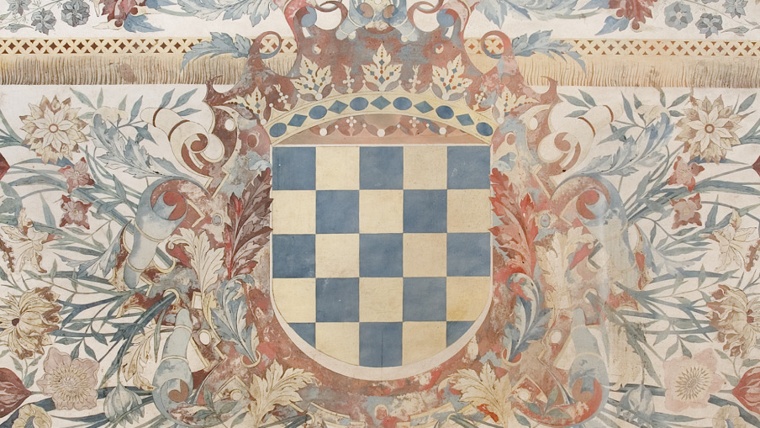
In the former infirmary of the Monastery of Pedralbes, a small display of furniture preserved by the religious community has been on view since 12 January 2021. The collection stands out more for its historical value than for its artistic merit. It comprises pieces of basic, simple, and austere construction, in which usefulness and functionality prevail over any aesthetic consideration. Their origins are diverse: alongside commissioned pieces and dowries, the collection includes donations of heritage objects from Queen Elisenda—the founder of the monastery—and from the noblewomen who accompanied her in her life of enclosure. For this reason, the selection of furniture from the fourteenth to the nineteenth centuries presented here, while prioritising storage furniture suited to the needs of the convent (worship, singing, archiving, infirmary use, clothing, and reading), also bears witness—albeit discreetly—to items more closely associated with the female courtly sphere, which entered the monastery as part of the trousseau and dowries of women from noble families and the well-to-do classes.
Given that very few examples of this type of furniture have survived to the present day, the collection shown in the exhibition offers a unique opportunity to explore the history of the convent through its most everyday objects, endowing them with considerable cultural and heritage value.
Within the former infirmary, time seems to stand still as one observes the basic construction and lack of decoration of the community’s storage furniture. Their design is governed by function, expressed through simplicity and austerity—qualities that evoke the vow of poverty. They return us to what is essential, demonstrating the value of eliminating the superfluous. Construction was usually the responsibility of the convent’s carpenter, while wrought iron elements were supplied by the blacksmith and, given their cost, were often reused.
Over the centuries, three main types of storage furniture were devised to meet different needs: chests, ideal for transport as their contents rest on the base; cupboards, suitable for storing objects that need to remain visible in fixed locations; and chests of drawers, which protect their contents in enclosed compartments. Based on these three structures and their variations, the exhibition is organised according to where the furniture was used or its function. The display is arranged into seven thematic sections: Praying in the palace of Elisenda de Montcada; Healing the soul through song in the choir; The chest, from universal container to dowry; Multifunctionality in the past; Cupboards for managing the convent; Cupboards: time stands still in enclosure; and Walls as cupboard structures.
In addition to the furniture, the exhibition route also includes other elements such as paintings, scagliola works, a ceramic panel, and various ceramic pieces. These objects help contextualise the narrative while enriching the display chromatically, bringing visitors closer to the everyday life of the Poor Clare community.
Schedule
| Period | Days | Hours | Preus | |
|---|---|---|---|---|
|
De l'1 October al 31 March |
From Tuesday to Friday |
From 10.00 am to 2.00 pm |
General admission: €5.2
Reduced admission: €3.70: . Visitors aged 65 or over . Pensioners . Under 30s . Large and single-parent families . Unemployed visitors . Youth card holders . Holders of the Targeta Rosa Reduïda . Libraries card holders . Holders of the BCN Express Card . Groups of more than 10 people
Free admission: · First Sunday of the month · Sundays, from 15.00 onwards · Registered users of the Gaudir+BCN programme · Children under 16, accompanied · Accredited ICOM members · Tourist guides · Teachers in formal education · Holders of the Targeta Rosa Gratuïta · Barcelona Card holders · Metropolitan companion pass for people with disabilities · Accredited journalists · 12 February (Santa Eulàlia) · Weekend of 28 and 29 March (on the occasion of the monastery’s centenary) · 3 May (foundation of the monastery) · 18 May (International Museum Day) . 4 June (Corpus Thursday) · 24 September (La Mercè) | |
|
Saturday and Sunday |
From 10.00 am to 5.00 pm | |||
|
Public holidays except 25 December and 1 January |
From 10.00 am to 2.00 pm | |||
|
De l'1 April al 30 September |
From Tuesday to Friday |
From 10.00 am to 5.00 pm | ||
|
Saturday |
From 10.00 am to 7.00 pm | |||
|
Sunday |
From 10.00 am to 8.00 pm | |||
|
Public holidays except 3 April, 1 May, and 24 June |
From 10.00 am to 2.00 pm |
Others
Museu Reial Monestir de Santa Maria de Pedralbes
- Address:
- Baixada del Monestir, 9
- District:
- Les Corts
- Neighborhood:
- Pedralbes
- City:
- Barcelona
- When
- Permanent event
Phone number
- Switchboard:
- 932563434
You may also be interested in...
-
Exhibition 'Col·lecció permanent d'art contemporani de la Fundació Fran Daurel'
- Where:
- Fundació Fran Daurel
- When:
- Permanent event
-
"World Press Photo 2026" Mostra Internacional de Fotoperiodisme
- Where:
- Centre de Cultura Contemporània de Barcelona - Sala d'Exposicions
- When:
- Del 06/11/2026 al 13/12/2026
-
Exposició permanent sobre la vela oceànica i les grans regates al voltant del món
- Where:
- Centre d'Interpretació de la Barcelona World Race
- When:
- Permanent event
-
Exposició 'Base Antàrtica'
- Where:
- CosmoCaixa Barcelona
- When:
- Permanent event
-
Exhibition 'Drassanes i galeres'
- Where:
- Museu Marítim de Barcelona
- When:
- Permanent event
-
Exposició 'Col·lecció Joan Miró'
- Where:
- Fundació Joan Miró - Museu
- When:
- Permanent event
-
Exhibition 'Sentir el patrimoni' al Museu Etnològic i de Cultures del Món - Site Parc Montjuïc
- Where:
- Museu Etnològic i de Cultures del Món *Parc Montjuïc
- When:
- Permanent event
-
Exposició fotogràfica "Sants, rails i vies"
- Where:
- Jardins de la Rambla de Sants
- When:
- Permanent event
-
Exposició virtual 'Rere els murs del monestir. 700 anys d'una història en femení'
- Where:
- Museu Reial Monestir de Santa Maria de Pedralbes
- When:
- Permanent event
-
Exposició 'Subirachs. Retorn al Poblenou'
- Where:
- Espai Subirachs - Poblenou
- When:
- Permanent event
-
Exhibition 'Una col·lecció permanentment canviant'
- Where:
- Fundació Privada Vila Casas - Can Framis - Fundació Vila Casas
- When:
- Permanent event
-
Exposició "The Bucha Blackboard"
- Where:
- Centre Cívic Parc Sandaru
- When:
- Del 06/10/2026 al 27/10/2026
-
Exposició ''Menys diazepam i més costura"
- Where:
- Centre Cívic Casa Orlandai
- When:
- Del 02/10/2026 al 30/10/2026
-
Exposició "Textografies"
- Where:
- Centre Cívic Matas i Ramis
- When:
- Del 17/09/2026 al 19/12/2026
-
"Festa Major de Sant Andreu": Exposició "Sant Andreu contemporani"
- Where:
- Centre Cívic Sant Andreu - Sala d'Exposicions
- When:
- Del 02/12/2026 al 20/01/2027
-
Taller 'Viatge a les exposicions de Barcelona'
- Where:
- Centre Cívic Matas i Ramis
- When:
- Del 01/10/2026 al 26/11/2026
-
Exposició "Arrelats: històries del comerç al Poble- Sec"
- Where:
- Centre Cívic El Sortidor
- When:
- Del 18/11/2026 al 16/01/2027
-
Cicle Altrart: Exposició "Jardí interior"
- Where:
- Centre Cultural La Casa Elizalde
- When:
- Del 07/09/2026 al 31/10/2026
-
Exposició "Mostra dels tallers de voluntariat de Can Verdaguer"
- Where:
- Centre Cívic Can Verdaguer
- When:
- Del 04/12/2026 al 18/12/2026